
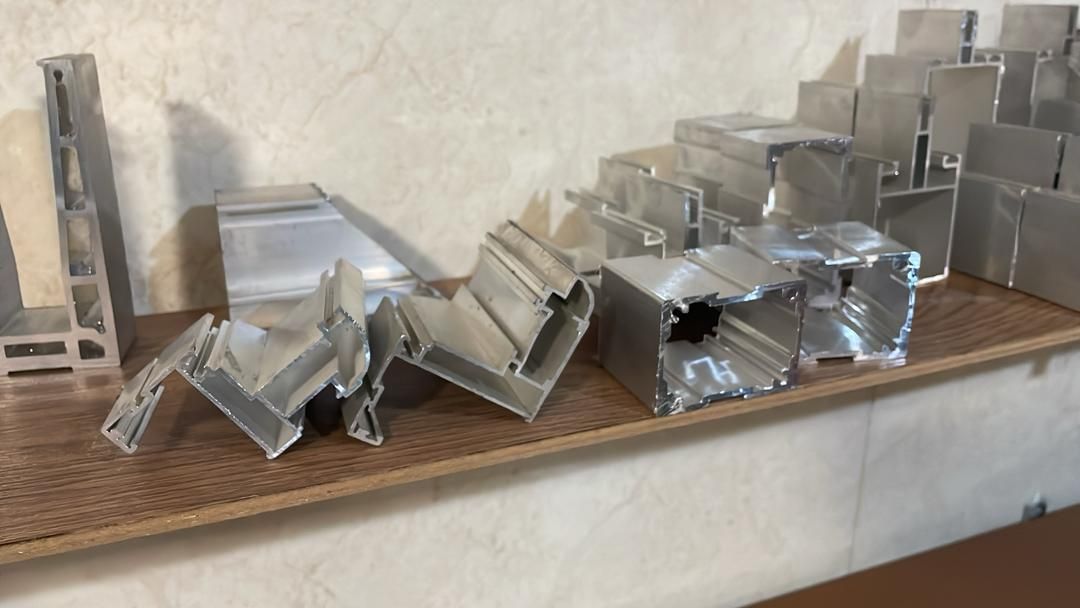
Density of aluminum
My workshop is 120 meters.Do you work with both aluminum and PVC simultaneously?
At the beginning of my work, I was focused on aluminum, working in Azerbaijan. At that time, these thermal break windows weren’t available in Iran. In 2007, when we came to Iran, PVC was just starting to become popular, so we started working with PVC. Since 2015, we have been working with aluminum alongside UPVC.
Our prices are usually at the border with other countries, we are not cheap. Therefore, we have to sell with effort, bargaining, and discussions. It’s said that it’s good you are experienced because when a customer calls and speaks Turkish, we can connect them with you since you have the knowledge and can help with translation.
Is your current work mostly domestic or international?
Aluminum is mostly not cost-effective for international work, I think.
Yes, it’s not cost-effective internationally, except for Iraq where the prices are good for us, including shipping. Afghanistan isn’t bad either, but Iraq seems to be the best.
We went to Iraq through the Faraz Jam company, which produces glass, about 3-4 months ago.
Do they produce glass or just process double glazing?
They process double glazing, bending, tempering, and laminating. They don’t produce the glass themselves but they do the processing.
They had a skylight project in Iraq which we installed. The windows and the glass were such that heat could not pass through. Most of their materials are imported from Turkey, and the prices there are much higher than in Iran. Glass is expensive in Turkey, but aluminum is not.
Glass is very cheap and cost-effective in Iran. If you can get glass projects, it’s very good, and even better in Iraq.
Iraq is close by, and they don’t have local production, so they import from either Turkey or Iran. Iranian glass is cheaper than Turkish glass, and there is a lot of export of glass now. If you can do glass projects there, it would be very good as there are many buildings, and the window spans are large, and they have a lot of money.
Yes, I was talking to a friend; some of them have a lot of money.
The financial situation in Iraqi Kurdistan is very good.
The Akpa produced in Iran is very different from what is produced in Iraq. The profile itself, its color, and the system are different. The people there prefer Turkish products which are well known.
So, based on your knowledge, if you say a profile is from Turkey and another from Iran, they would prefer the Turkish one first?
Yes.
The only thing we can claim is good in Iranian products is the raw materials.
Glass is also a type of raw material.
When it’s processed, its value increases.
Our raw material prices are lower.
From Iran, we can send glass to Kazakhstan or Kyrgyzstan, but not aluminum because they have local production and prefer Turkish products. But in Iraq and Erbil, if you can get projects, it’s very profitable.
For the skylight you installed in Iraq, how much would it cost with your price compared to a Turkish company?
The Turkish price would be more than double ours. Their high price is due to the glass, as skylights mostly consist of glass, making it cost-effective for us.
Due to the high costs here, there is not much construction, and hence not much work, but it’s still cost-effective for us. People here have high expectations; for example, they expect to double their money in construction.
Do you do marketing for your work?
Yes, we have a separate marketing team that goes out, talks to customers, and brings in work. Similar to how you work with UPVC, we have a system where the company has marketers, and most people are either on-site for projects or in marketing.
In our company in Karaj, we have a bit of an office setup, but here, it’s mainly a place for meetings because clients need a place that matches their level of business.
For example, if I, as a customer, come to your workshop for a project worth 200 million or 500 million tomans, I would negotiate with you. If you say 500 million doesn’t make sense to you, and you need 550 million because 50 million is for the company’s commission, we agree on a 10% commission for the company. If the customer wants to pay 500 million, you close the deal for 500 million and then tell the company there was no profit.
Do you send the contract to the customer to sign with the manufacturer, or do you write the contract yourself?
Both ways. We prefer to close the deal here because the company’s manager has complete oversight of the contract. He knows how to adjust it and analyzes the customer. If the customer insists on seeing the workshop and the factory, we might send them with you, or we might coordinate and take them to your workshop ourselves for a visit.
Is the workshop in Shahriar large?
No, it’s small, I think less than 100 meters. It’s a shed, maybe twice the size of this place. Our goal is to have a reliable partner. We invited you here to see if we can comfortably send customers to your workshop, or if we should accompany them for a visit. If the customer tries to bypass the company, you should agree and say you have a 10% agreement with us and give us our share.
Do you work with PVC?
We have had several experiences with PVC, but the prices are marginal. Even in windows, we try to avoid it and focus on Curtain Wall, where competition is less.
Even in Curtain Wall, we try to find niche projects, like unique moving walls or roofs, where competition is minimal.

Leave A Comment